Fluoro-Stat — Conductive Anti-Static PTFE Roll Covers
Standard fluoropolymer roll covers — FEP, PFA, and standard PTFE — solve the buildup problem but can create a new one: electrostatic charge. Because fluoropolymers are excellent electrical insulators, they accumulate and hold static in dry-area roller applications. The result is electrostatic arcing that damages the sleeve, creates processing defects, and in the worst cases poses a fire or shock hazard.
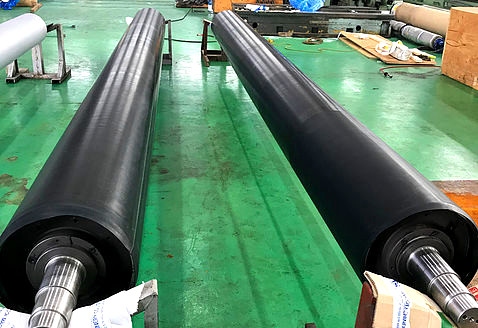
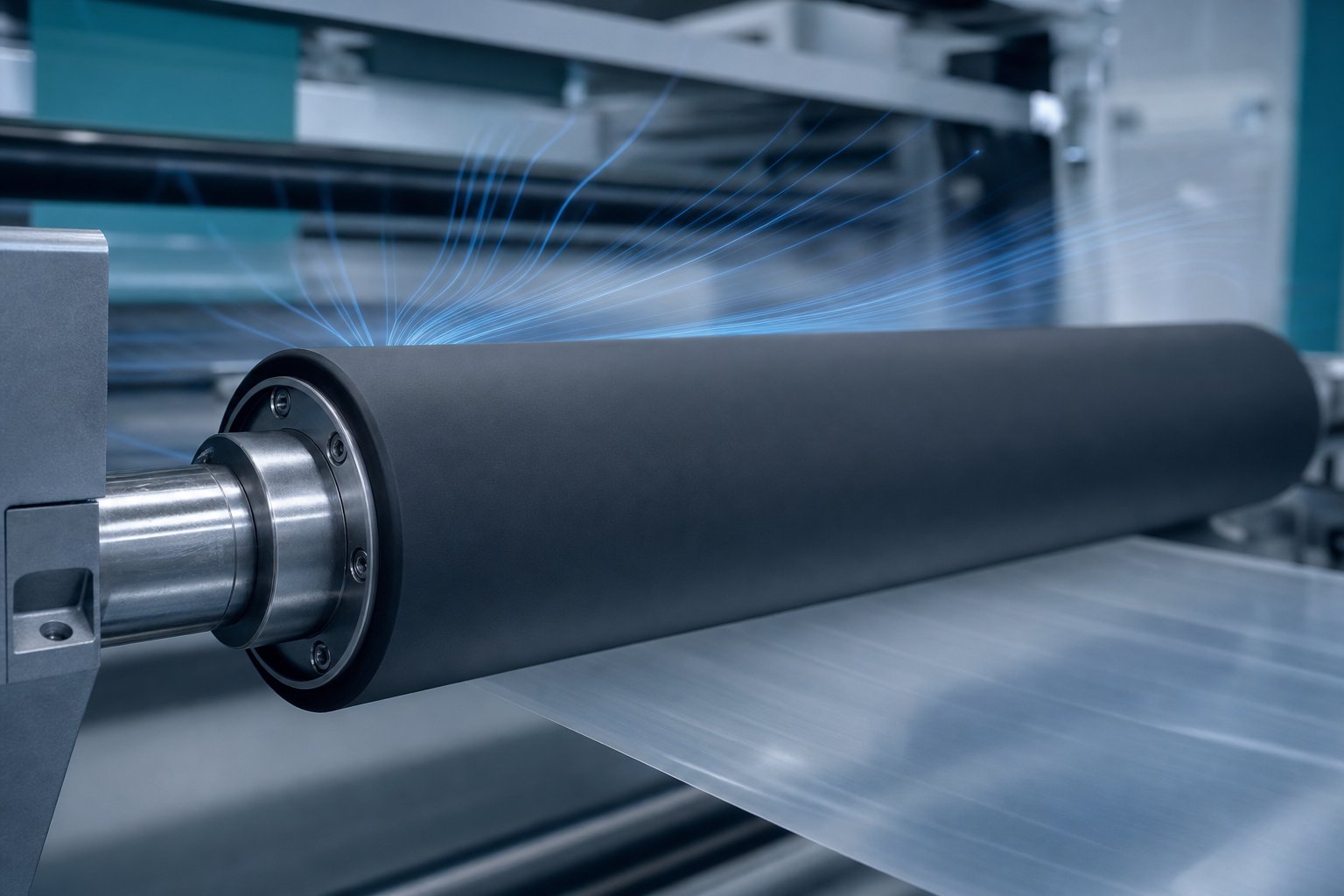
Fluoron's Fluoro-Stat roll cover solves both problems simultaneously. It delivers the full non-stick, chemical-resistant performance of PTFE while incorporating a conductive carbon filler that dissipates static charge — preventing buildup before it can arc.
Why Standard Fluoropolymer Covers Create Static Problems
Fluoropolymers are among the most effective electrical insulators known to materials science. That is enormously useful in many contexts — but on a fast-running roller in a dry web-processing environment, it is a liability.
When a non-conductive FEP or standard PTFE sleeve spins against a moving web of film, paper, or nonwoven material, triboelectric charging occurs: electrons are transferred between the sleeve surface and the web. Because the sleeve cannot conduct those electrons away, they accumulate. The roller becomes an isolated conductor of high-voltage static charge.
The consequences include:
- Electrostatic arcing — visible spark discharge that physically damages the sleeve surface (pitting, burn-through)
- Web defects — static causes film or paper to mis-track, wrinkle, or attract dust and contamination
- Fire and explosion risk — in environments with flammable solvents or fine particulates, static arcing can ignite
- Equipment damage — high-voltage discharge can damage sensors, drives, and control electronics in proximity
This is a documented failure mode. Fluoron has documented FEP sleeve damage caused specifically by electrostatic arcing in dry-area positions, and designed Fluoro-Stat to eliminate it.
How Fluoro-Stat Works — The Carbon-Filler Mechanism
Fluoro-Stat achieves conductivity through the addition of carbon black at or above the percolation threshold — the concentration at which carbon particles form a continuous conductive network through the PTFE matrix.
Below the percolation threshold, the compound behaves as an insulator. At and above it, conductivity rises sharply. Fluoron's compounding process is controlled to consistently exceed this threshold, ensuring reliable conductivity across every sleeve produced.
The result is a PTFE-based roll cover with:
- Surface resistance: 10⁶ to 10⁹ ohms per square (static-dissipative range)
- Continuous charge bleed-off — electrons are conducted through the sleeve to the grounded roller core rather than accumulating
- No arc events — because charge never builds to discharge potential
- Same non-stick surface energy as virgin PTFE — the carbon filler does not degrade release properties
The carbon filler also adds measurable abrasion resistance. Fluoro-Stat provides approximately 10× the wear life of FEP — the same order-of-magnitude advantage as unfilled PTFE.
Fluoro-Stat vs. Other Static-Control Approaches
| Approach | Effectiveness | Drawbacks |
|---|---|---|
| Ion bar / active ionizer | Neutralizes charge in air near web | Does not address charge on the roller surface directly; requires power, maintenance, positioning |
| Grounding brushes / static straps | Dissipates charge if contact is maintained | Wear out, require maintenance, can cause uneven contact on a spinning roller |
| Standard FEP sleeve (no static control) | None — makes static worse | Insulating surface actively accumulates charge |
| Unfilled PTFE sleeve | None — also insulating | Same problem as FEP; adds wear resistance but not static control |
| Conductive PTFE | Eliminates charge accumulation at the source | Higher unit cost than standard FEP; minimum 4" OD |
For dry-area roll positions where static is a documented or suspected problem, Fluoro-Stat is the only passive, maintenance-free solution that addresses charge at the sleeve surface.
Technical Specifications
| Property | Fluoro-Stat Value |
|---|---|
| Base Material | PTFE with conductive carbon filler |
| Color | Black (carbon-filled) |
| Surface Resistance | 10⁶ – 10⁹ Ω/sq |
| Operating Temperature | -76°F to 500°F (-60°C to 260°C) |
| Wall Thickness | 0.060" (1.5 mm) standard |
| Minimum OD | 4" |
| Maximum OD | No limit (fluoropolymer weld seam) |
| Seam Type | Smooth-finish weld seam |
| Bonding Method | Etched and adhesive-bonded |
| Chemical Resistance | Resistant to strong acids, bases, solvents, oils |
| Non-Stick | Yes — low surface energy PTFE surface |
| Wear Resistance | ~10× FEP |
| UV/Ozone Resistance | Yes |
| Resin Grade | Virgin PTFE |
Applications — Where Fluoro-Stat Belongs
Fluoro-Stat is specified when three conditions coincide: a fluoropolymer non-stick surface is needed, the roll operates in a dry environment, and static discharge is either a documented problem or a credible risk.
Primary applications:
- Film slitting and rewinding lines — fast-running film against covered idler rolls generates heavy triboelectric charge
- Dry-area paper machine sections — pre-dryer or after-dryer idler rolls where FEP covers have shown arc damage
- Coating and laminating lines (dry section) — roll positions between solvent-flash ovens and nip stations
- Flexographic and gravure printing — dry web guide rolls and lead rolls
- Nonwovens processing — spreader and bowed rolls in fiber-handling environments
- Electronics and semiconductor web handling — where even low-level static can damage product
What Rolls Can Fluoro-Stat Cover?
Fluoro-Stat is compatible with metal (steel, aluminum), fiberglass, and composite roll substrates. It requires a bonded installation (etched sleeve + adhesive) because PTFE's surface energy is too low for mechanical adhesion without chemical surface preparation.
Roll OD range: 4" minimum, no upper limit via fluoropolymer weld seam.
Rolls that currently run standard FEP covers and show signs of arc damage (surface pitting, brown discoloration, or burn-through marks on the sleeve) are ideal retrofit candidates. Fluoron engineers can assess whether Fluoro-Stat is the right fix based on photos and operating parameters.
Fluoro-Stat vs. Fluoro-Wear — Choosing Between PTFE Grades
Both Fluoro-Stat and Fluoro-Wear are PTFE-based sleeves. The distinction is one of environment:
| Factor | Fluoro-Wear (PTFE) | Conductive PTFE |
|---|---|---|
| Static control | None (insulating) | Yes — static-dissipative |
| Wear resistance | ~10× FEP | ~10× FEP |
| Best environment | Wet or neutral; no static concern | Dry environment with static risk |
| Color | White / natural | Black |
| Cost | Lower than Fluoro-Stat | Higher (carbon filler + compounding) |
| Bond method | Etched + adhesive | Etched + adhesive |
If your roll is in a wet section and static is not a concern, Fluoro-Wear is the appropriate PTFE choice. If the roll is in a dry section or has shown static-related issues, Fluoro-Stat is specified.
Frequently Asked Questions
Can I replace my existing FEP covers with Fluoro-Stat without any other changes?
In most cases, yes. Fluoro-Stat is fabricated to the same OD specifications as your existing sleeves. The installation process (heat shrink + adhesive bond) is the same. The grounded roller core provides the discharge path, so no additional grounding hardware is required as long as the roll shaft is properly grounded per machine design. Fluoron engineers will confirm compatibility.
How do I know if static is causing my sleeve failures?
Signs of electrostatic arc damage on a sleeve include surface pitting, small circular burn marks, brown or black discoloration patterns, or pinhole failures that appear in a localized area of the sleeve rather than distributed wear. If you are seeing these patterns on FEP or standard PTFE covers, Fluoro-Stat is the likely solution.
Does the carbon filler affect the non-stick properties?
No. The PTFE matrix provides the surface energy and non-stick performance. The carbon filler is distributed throughout the bulk of the material — it does not alter the surface energy or the release properties of the sleeve face.
Is Fluoro-Stat compliant with food-contact regulations?
The carbon additives used in anti-static PTFE are FDA 21 CFR 178.3297 compliant at low loading levels. For specific food-contact applications, Fluoron can provide compliance documentation. However, for most food-processing roll applications without static risk, Fluoro-Clear (FEP) or Fluoro-Flex (PFA) — both fully FDA-compliant — are the standard recommendation.
What is the minimum roll diameter for Fluoro-Stat?
4" OD minimum. All Fluoro-Stat sleeves have a smooth-finish fluoropolymer weld seam; they are not available as seamless tubes due to the PTFE material properties.
CTA Block
Stop Static Discharge at the Source
If your dry-area rolls are showing arc damage or causing web quality problems, Fluoro-Stat may be the answer. Tell us about your roll and we'll specify the right solution.
Request a Fluoro-Stat quote:
Technical Guides for Teflon Sleeves and Non-Stick Roll Covers
If you are comparing Teflon sleeves, Teflon roll covers, non-stick roll covers, or fluoropolymer sleeves, these guides will help you choose the right material, installation method, and next step.
- Teflon sleeves for industrial rollers
- Non-stick roll covers for adhesive, starch, ink, and film release
- conductive PTFE roll covers for static control
- FEP vs. PFA vs. PTFE material selection guide
- Heat-shrink roll cover installation guide
- Fluoropolymer roll cover FAQ
Need a recommendation? Send us your roll diameter, face length, temperature, pressure, and what is sticking to the roll. Fluoron will help you choose the right sleeve.
A Spectrum Advanced technology platform
Fluoron is the sleeve division of Spectrum Advanced. Together with Radiant Cleaning and AEGIS Advanced Coatings, we help industrial teams solve sticking, buildup, corrosion, wear, and downtime problems across rollers, process equipment, and critical production assets.
Fluoro-Stat proof
Conductive PTFE roll covers for dry-area static and wear.