
Teflon Sleeves for Industrial Rollers
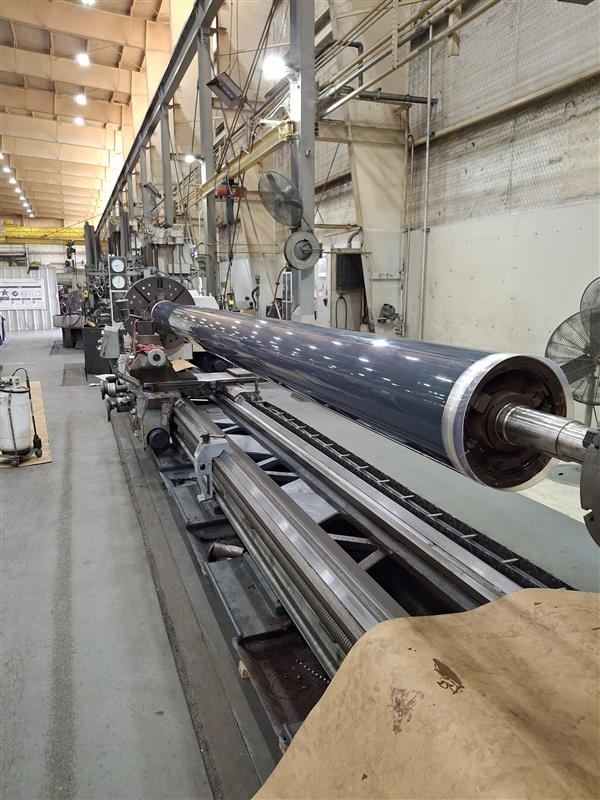
When buildup, sticking, and corrosion are shortening the life of your process rollers, a heat-shrink fluoropolymer sleeve is the most durable, cleanest fix available. Fluoron engineers and fabricates precision roll sleeves from FEP, PFA, and PTFE fluoropolymers — the same class of material as Teflon® brand coatings — designed to outlast spray coatings and reduce unplanned downtime across printing, paper, converting, laminating, and packaging operations.
Patented PTFE capability: Fluoron offers patented heat-shrink PTFE roll cover technology, a capability not broadly available from other roll-cover suppliers.
Note: "Teflon®" is a registered trademark of The Chemours Company, used here to describe a class of fluoropolymer materials. Fluoron manufactures independent, non-branded fluoropolymer sleeves.
What Are Teflon-Style Fluoropolymer Sleeves?
Heat-shrink fluoropolymer sleeves — commonly referred to as "Teflon sleeves" in the industry — are precision-expanded tubes of FEP, PFA, or PTFE that are slipped over a roller and shrunk tight using a calibrated heat gun. Once installed, they form a continuous, non-stick surface that resists adhesive buildup, moisture, chemicals, and high temperatures.
Unlike spray-applied PTFE coatings, heat-shrink sleeves are a replaceable mechanical solution. When a sleeve wears out, it is removed and replaced — no roll grinding, no re-coating downtime, no sending rollers off-site (in most cases). The fluoropolymer surface has an extremely low coefficient of friction, meaning adhesives, inks, gums, starches, and resins simply cannot grip the roller face.
Fluoron offers four sleeve grades under its branded product line: Fluoro-Clear (FEP), Fluoro-Flex (PFA), Fluoro-Wear (PTFE), and conductive PTFE — each optimized for a specific combination of temperature, pressure, wear, and electrostatic requirements.
Industries and Applications That Depend on Fluoropolymer Sleeves
Fluoropolymer-sleeved rollers are deployed wherever product buildup or sticking creates quality defects or operational stoppages:
- Pulp & Paper: Dryer cans, press rolls, felt rolls, couch rolls, guide rolls — where fiber picking, starch buildup, and moisture corrosion are constant.
- Printing (Offset, Flexo, Gravure): Ink transfer and nip rollers where ink adhesion causes smear and rejects.
- Laminating & Converting: Rubber nip rollers running adhesive-coated films where release is critical to product quality.
- Food Processing: Conveyor and guide rollers requiring FDA-compliant, easy-clean non-stick surfaces.
- Packaging: Spreader rolls and idler rolls where film tracking and contamination must be controlled.
- Textile & Nonwovens: Bowed, banana, and spreader rolls where fiber wrap and static are production threats.
If your rollers are accumulating residue, corroding, or triggering line stoppages for cleaning, a correctly specified Fluoron sleeve can resolve the issue at a fraction of the cost of roll regrinding or replacement.
Fluoron Sleeve Materials — Matching the Cover to the Application
Not all fluoropolymer sleeves perform equally. Material selection determines service life, performance ceiling, and total cost. Fluoron's four grades address the full spectrum of roller environments:
| Sleeve Grade | Base Material | Seamless Up To | Max Temp | Thickness | Best For |
|---|---|---|---|---|---|
| Fluoro-Clear | FEP | 18" OD | 350°F (177°C) | 0.020" / 0.060" | Conveyor, guide, spreader rolls — low wear |
| Fluoro-Flex | PFA | 18" OD | 400°F (204°C) | 0.060" | Rubber nip rolls — medium wear, high flex |
| Fluoro-Wear | PTFE | 5"+ | 500°F (260°C) | 0.060" | Felt rolls, press rolls — high wear |
| Fluoro-Stat | Conductive PTFE | 5"+ with seam | 500°F (260°C) | 0.060" | Dry-area rolls with static discharge risk |
Service life comparison under ideal conditions:
- FEP (Fluoro-Clear): 12–18 months
- PFA (Fluoro-Flex): ~4× longer than FEP
- PTFE (Fluoro-Wear / conductive PTFE): ~10× longer than FEP
Selecting the right grade from the start eliminates premature sleeve failures and unnecessary changeouts.
Fluoron vs. Other Fluoropolymer Sleeve Suppliers
The fluoropolymer sleeve market includes several established suppliers. Here is how Fluoron differentiates:
| Factor | Fluoron | Edlon | Tefcap | Holscot | Saint-Gobain ICS |
|---|---|---|---|---|---|
| Custom fabrication (any diameter) | ✓ | ✓ | Standard sizes | ✓ | ✓ |
| Conductive anti-static PTFE sleeve | ✓ (Fluoro-Stat) | — | — | — | — |
| On-site installation available | ✓ | ✓ | No | No | No |
| Field training for customer install | ✓ | — | — | — | — |
| U.S.-based manufacturer | ✓ (Elkton, MD) | ✓ | ✓ | UK-based | Global |
| FEP seamless up to 18" OD | ✓ | ✓ | Stock sizes only | ✓ | ✓ |
| PTFE seamed sleeve (welded) | ✓ | ✓ | — | — | — |
Fluoron's specialization in conductive anti-static roll covers (Fluoro-Stat) is a unique capability with no direct equivalent offered by Edlon, Tefcap, Holscot, or Saint-Gobain's roll cover line.
How to Specify a Fluoron Teflon Sleeve
To receive an accurate quote, Fluoron engineering needs the following information:
- Roll substrate — steel, aluminum, rubber (EPDM, silicone, Hypalon), fiberglass, or composite
- Roll OD (outer diameter) and face length
- Operating temperature — average and peak
- Nip pressure (PLI) — pounds per linear inch
- Operating environment — wet/dry, chemical exposure, static risk
- Application — what the roller does and what material it contacts
With these inputs, a Fluoron application engineer will recommend the correct sleeve grade, thickness, bonding method (bonded vs. unbonded), and installation approach. Custom sizes outside standard diameters are available via fluoropolymer weld seaming.
Bonded vs. Unbonded Installation — When Each Is Required
A key specification decision is whether to bond the sleeve to the roller face with adhesive or leave it free-floating.
Unbonded sleeves are suitable when:
- Operating temperature stays below 150°F
- Nip pressure is under 7 PLI
- The roll is in a dry environment
- Quick field replacement is a priority
Bonded sleeves are required when:
- Temperature exceeds 150°F
- Nip pressure exceeds 7 PLI
- Moisture could wick under the cover
- The roll runs at high speed in a wet environment
Fluoron's FEP and PFA grades are offered bonded or unbonded. PTFE grades (Fluoro-Wear, Fluoro-Stat) are always etched and adhesive-bonded due to the material's impermeability to standard adhesives without surface preparation.
Sleeve Sizes — Seamless and Welded Options
Seamless sleeves (FEP and PFA):
- Available for rollers up to 18" OD
- Produced by radial expansion of an extruded tube
- Zero longitudinal seam — optimal surface uniformity and stress distribution
- Available in 0.020" (0.5 mm) and 0.060" (1.5 mm) wall thicknesses
Welded/seamed sleeves (PTFE, and oversized FEP/PFA):
- PTFE cannot be extruded as a tube, so all PTFE sleeves have a precision weld seam
- Fluoron's proprietary seaming process produces a smooth, low-profile weld
- Available for any diameter from 5" up (PTFE) with no upper size limit
- Large-diameter FEP/PFA sleeves above 18" OD are also available via weld seam
Application / Specification Quick-Reference Table
| Application | Recommended Grade | Bond Method | Notes |
|---|---|---|---|
| Paper machine dryer cans | Fluoro-Wear (PTFE) | Bonded | High temp, high pressure |
| Rubber nip rolls (laminating) | Fluoro-Flex (PFA) | Bonded | High flex, EPDM/silicone substrate |
| Guide / spreader rolls | Fluoro-Clear (FEP) | Unbonded or bonded | Low wear, easy replacement |
| Dry-area idler rolls (static risk) | Fluoro-Stat (PTFE) | Bonded | Anti-static control critical |
| Felt rolls / press rolls | Fluoro-Wear (PTFE) | Bonded | Maximum abrasion resistance |
| Food-contact conveyor rolls | Fluoro-Clear (FEP) | Bonded or unbonded | FDA-compliant material |
| Printing press nip rolls | Fluoro-Flex (PFA) | Bonded | High nip pressure tolerance |
| Offset/flexo ink rollers | Fluoro-Clear (FEP) | Bonded | Ink release, easy clean |
Frequently Asked Questions
Is Fluoron's sleeve the same as a Teflon® coating?
Fluoron sleeves are made from the same class of fluoropolymer materials — FEP, PFA, and PTFE — that underlie Teflon® brand products. Teflon® is a registered trademark of The Chemours Company; Fluoron manufactures independent fluoropolymer roll covers. A heat-shrink sleeve provides a mechanically replaceable surface rather than a bonded spray coating, which gives it a different wear profile and serviceability advantage over coating alone.
What diameter rollers can Fluoron sleeve?
FEP (Fluoro-Clear) and PFA (Fluoro-Flex) are available seamlessly up to 18" OD. Above 18", or for all PTFE grades, Fluoron uses a fluoropolymer weld seam — there is no practical upper diameter limit. PTFE sleeves (Fluoro-Wear, Fluoro-Stat) start at 5" minimum OD.
Can the sleeves be installed on-site, or does the roller have to be sent to Fluoron?
Both options are available. Fluoron offers on-site installation services and also provides training so your maintenance team can install sleeves independently. Smaller diameter FEP sleeves on non-bonded applications are routinely installed in the field with a heat gun and basic equipment.
How long does a fluoropolymer sleeve last?
Under ideal conditions, an FEP sleeve is serviceable for 12–18 months. PFA lasts approximately 4× longer than FEP; PTFE grades last approximately 10× longer. Actual service life depends on operating temperature, pressure, abrasion level, and chemical environment. Fluoron application engineers can estimate expected service life based on your specific conditions.
What information do I need to provide to get a quote?
Roll OD and face length, substrate material (metal, rubber, composite), operating temperature range, nip pressure in PLI, environment (wet/dry, any chemical exposure), and the roll's function in your process. Fluoron will specify the correct grade, thickness, and bonding method and provide a firm quote.
CTA Block
Stop the Buildup. Extend Your Roller Life.
Fluoron application engineers will specify the right sleeve grade for your rollers and process conditions — and can arrange on-site installation or ship sleeves directly for your team to install.
Request a quote or ask a technical question:
Flexible packaging and converting
For film, adhesive, web handling, and distributor roll problems
Flexible packaging teams and their distributors often need heat shrink Teflon sleeves, Teflon roll covers, or non-stick roll covers when adhesive pickup, web breaks, wrap-ups, and repeated cleaning stops start controlling line speed. Fluoron helps convert that line problem into a sleeve specification for FEP, PFA, PTFE, or conductive PTFE.
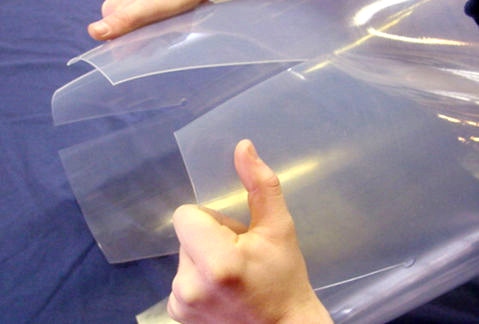
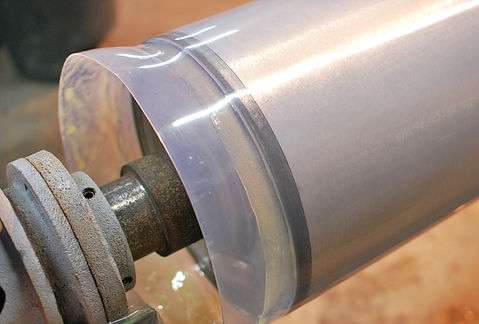
Custom FEP proof
Clear FEP sleeves for inspection and clean release.
Sleeve questions
Common questions about Fluoron sleeves and roll covers
What size rollers can Fluoron cover?
Fluoron builds custom heat-shrink fluoropolymer sleeves and roll covers to match the roller dimensions you provide. Send the roll diameter, face length, journal details if relevant, and any space limitations so our team can confirm the right sleeve path.
What types of rollers can be covered?
Fluoron sleeves are commonly considered for steel, aluminum, rubber, composite, fiberglass, guide, idler, spreader, nip, chill, calender, and other industrial rollers where sticking, buildup, wear, static, or corrosion is affecting production.
What are the operating temperatures?
The correct temperature range depends on the selected material. FEP, PFA, and PTFE, including conductive PTFE each behave differently under heat, pressure, and chemical exposure. Share your operating temperature and line conditions and Fluoron will help confirm the best fit.
Who installs the sleeves?
Fluoron offers installation support on-site or in our shop. Once trained by Fluoron, many customers can complete repeat installations themselves. The best installation path depends on roller size, bonding requirements, outage timing, and site access.
What industries use non-stick sleeves?
Fluoron sleeves are used in pulp and paper, flexible packaging, converting, laminating, printing, food processing, plastics, rubber, textiles, and other industrial lines where a roller surface needs clean release, chemical resistance, wear resistance, or static control.
How long will a Fluoron sleeve last?
Service life depends on material selection, pressure, temperature, chemistry, line speed, abrasion, and cleaning practices. Fluoron helps match FEP, PFA, PTFE, or Fluoro-Stat to the application so the sleeve is specified for the conditions it will actually see.
A Spectrum Advanced technology platform
Fluoron is the sleeve division of Spectrum Advanced. Together with Radiant Cleaning and AEGIS Advanced Coatings, we help industrial teams solve sticking, buildup, corrosion, wear, and downtime problems across rollers, process equipment, and critical production assets.