
Quick answer: Fluoropolymer tank liners are PTFE, PFA, FEP, or ETFE sheet linings bonded or mechanically anchored to the interior of a metal or composite tank to protect it from aggressive chemicals, solvents, and high-temperature process media. Fluoron does not manufacture tank liners — we exited that business — but we still get asked about the technology, so this page covers what they are, when they make sense, and where to source them today.
Chemical processing tank liners — what to know
The term chemical processing liners usually means PTFE, PFA, FEP, or ETFE sheet linings bonded to the interior of steel reactors, storage tanks, and process vessels — anywhere aggressive solvents, acids, or high-temperature media would attack bare metal. These are loose-fit or bonded liner systems, not coatings, and they’re sized to the tank.
Fluoron does not manufacture tank linings today — we focus on heat-shrink fluoropolymer roll covers and sleeves. If your application is a roller in a chemical-processing line (not a tank), our PFA roll covers and PTFE roll covers deliver the same fluoropolymer chemical resistance to the running surface. If you do need an actual tank liner, ARLON, Crane ChemPharma, and Steuler are the names to know.
On this page
- What is a fluoropolymer tank liner?
- When fluoropolymer tank liners make sense
- Common fluoropolymer materials for tank lining
- How fluoropolymer tank liners are installed
- Service life and inspection
- What Fluoron does today
- Where to source fluoropolymer tank liners today
What is a fluoropolymer tank liner?
Fluoropolymer tank liners protect steel and FRP vessels from aggressive chemicals. For PTFE tanks and PTFE-lined process vessels, a bonded PTFE tank liner delivers broad chemical resistance and a clean, non-stick interior surface.
A fluoropolymer tank liner is a chemical-resistant interior barrier installed in a tank or vessel to prevent process fluids from contacting the underlying tank structure. Fluoropolymers — PTFE (Teflon), PFA, FEP, and ETFE — are the gold standard for severe chemical service because they resist almost every industrial solvent, acid, base, and oxidizer.
Tank liners are different from spray-on coatings. A liner is a continuous sheet of material (typically 60 mil to 250 mil thick) that is mechanically bonded or anchored to the tank wall, with all seams heat-welded for a hermetic seal. Coatings, by contrast, are spray or roller applied at 5 to 50 mil thickness.
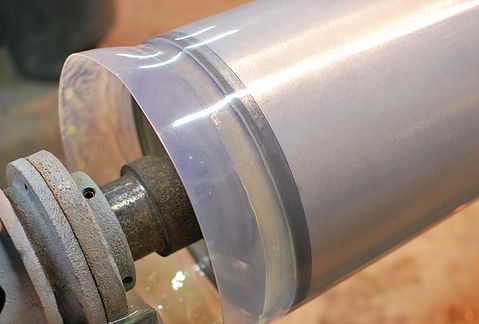
When fluoropolymer tank liners make sense
- Severe chemical storage — concentrated sulfuric, nitric, hydrochloric, or hydrofluoric acid storage where corrosion would destroy a stainless or carbon steel tank in months.
- High-purity service — semiconductor wet etch baths, pharmaceutical reactors, and biotech vessels where any metal ion contamination is unacceptable.
- Mixed-chemistry batch processing — when the same tank must handle multiple chemistries over its life and the operator wants one liner that resists everything.
- Tanker trucks and IBCs in chemical transport — fluoropolymer liners in road tankers and intermediate bulk containers for over-the-road chemical hauling.
- Existing tank rehabilitation — when a metal tank is structurally sound but its interior has corroded, a fluoropolymer liner is often cheaper than tank replacement.
Common fluoropolymer materials for tank lining
| Material | Max service temperature | Best for | Tradeoff |
|---|---|---|---|
| PTFE (Teflon) | 500°F (260°C) continuous | Universal chemical resistance; high-temp service | Cannot be heat-welded the same way as PFA or FEP; uses paste-extruded sheet |
| PFA | 500°F (260°C) continuous | High purity, semiconductor, melt-processable for true heat welding | Highest material cost |
| FEP | 400°F (200°C) continuous | Transparency for visual monitoring; lower cost than PFA | Lower temperature ceiling than PTFE or PFA |
| ETFE | 300°F (150°C) continuous | Better mechanical toughness than PTFE; lower cost | Less chemical resistance than PTFE or PFA |
| PVDF | 275°F (135°C) continuous | Lower-cost partial fluoropolymer for mildly aggressive service | Not resistant to strong bases or amines |
How fluoropolymer tank liners are installed
There are three common installation methods:
- Bonded liner — sheet is glued to the tank interior with a chemical-resistant adhesive, then all seams are heat-welded. Best for small to mid-size tanks with regular geometry.
- Mechanically anchored loose liner — liner sits free inside the tank with anchor points (studs, flanges) at the top edge. Pressure differential during operation holds the liner against the wall. Best for tanks where adhesive bonding is not practical.
- Rotomolded liner — for new tanks, the fluoropolymer can be rotationally molded as a single-piece inner shell with no seams. Best for high-purity service where every weld is a potential contamination source.
Service life and inspection
A properly specified fluoropolymer tank liner typically lasts 10 to 25 years in continuous chemical service. Failure modes are usually permeation (some chemicals slowly migrate through the liner over years), mechanical damage (impact, abrasion from agitators), or seam failure (poorly welded joints opening up). Annual visual inspection plus spark testing every 3 to 5 years is standard practice.
What Fluoron does today
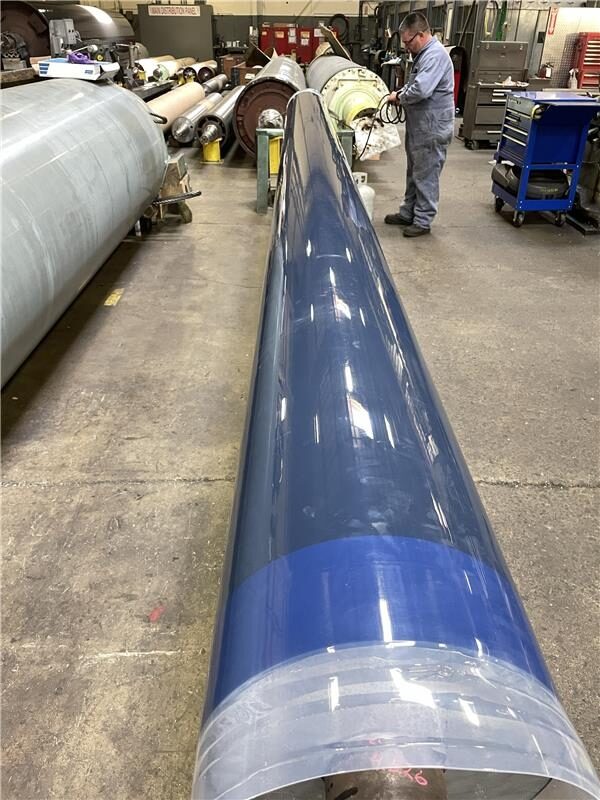
Fluoron has been a fluoropolymer specialist since 1990. We exited the tank-lining business to focus on what we do best: heat-shrink fluoropolymer roll covers for industrial rollers — the cylindrical equivalent of a tank liner, applied to printing, paper, converting, and packaging rolls. If your application involves a cylindrical roll rather than a tank, we are the right shop.
- Heat-shrink fluoropolymer roll covers — FEP, PFA, PTFE sleeves for industrial rollers
- Conductive PTFE roll covers — static-dissipative roll covers for converting and printing
- Fluoropolymer etching service — bondable PTFE surface prep for downstream adhesive applications
- FEP FluoroClear — transparent heat-shrink covers for process monitoring
- FEP material properties guide — properties, applications, FAQs about FEP
Where to source fluoropolymer tank liners today
For active tank-lining service, the established US shops include Crane ChemPharma, Arkema, and Bondstrand. For tank rehabilitation projects, look for ASME-certified lining contractors with documented fluoropolymer experience and recent reference projects in your industry. Specify the chemistry, service temperature, tank dimensions, and any required certifications (FDA, USP, semiconductor purity) up front — fluoropolymer selection is application-specific.
If you arrived here looking for industrial roll surface protection rather than tank lining, connect with Fluoron and we will spec the right fluoropolymer system for your roll application.